
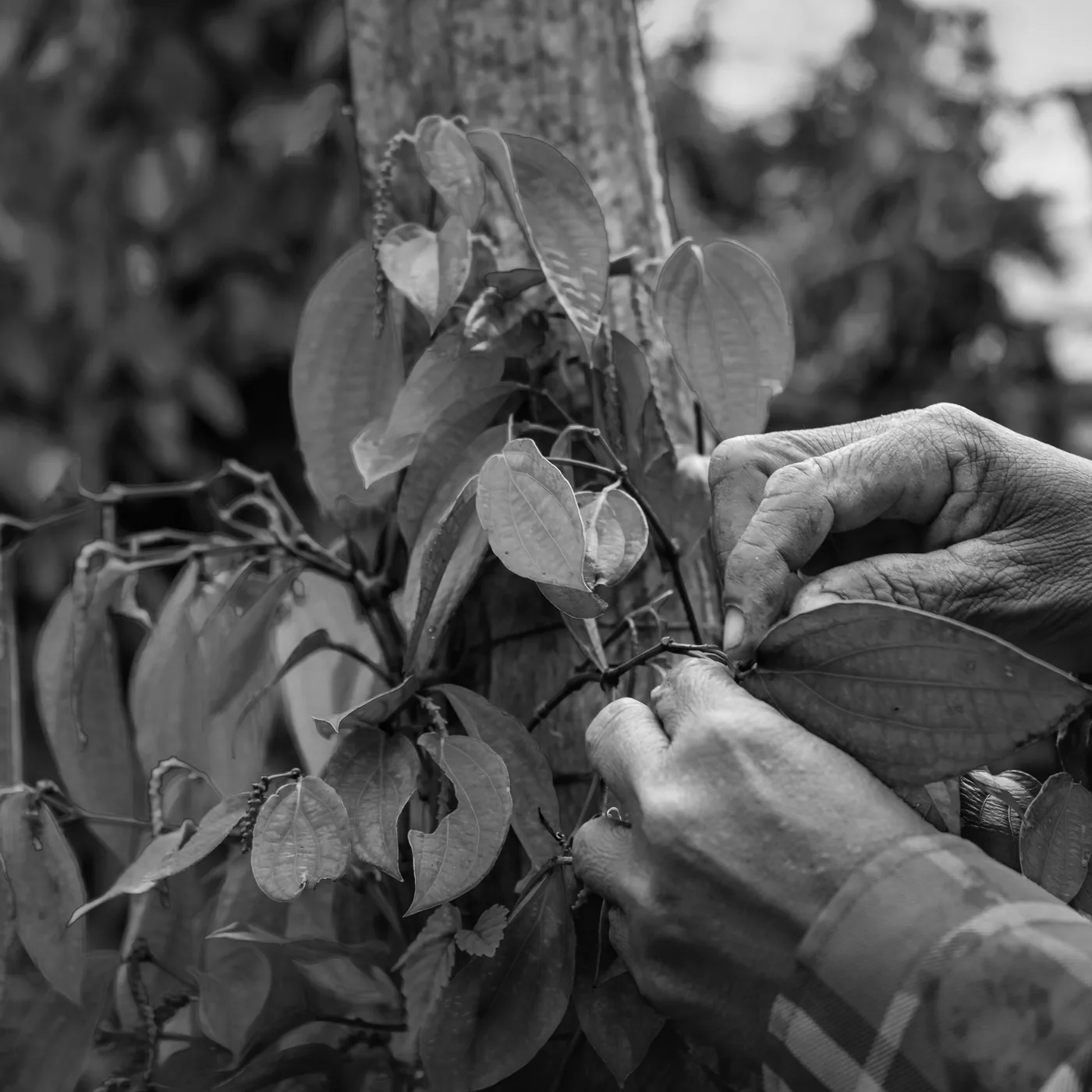
We get asked this almost every day in the shop, usually by someone holding a small bag bought the night before at the market: is this real Kampot pepper? Sometimes it is. Often it is not. Kampot pepper is Cambodia’s best known product abroad, which is exactly why it is the most copied.
Here is what to know before you buy in Siem Reap, whatever your budget.
What makes Kampot pepper real
Kampot pepper is not a style or a grade, it is a protected origin. It was registered as a geographical indication in Cambodia in 2010, then recognised by the European Union in 2016, becoming the first Cambodian product to earn that status. In practice, pepper can only carry the name if it grew inside the defined area, which covers Kampot province and neighbouring Kep.
The specification is held by the Kampot Pepper Promotion Association, the KPPA, which inspects the farms and issues the authorisations. Anything grown elsewhere, even fifty kilometres away, even genuinely good, is not Kampot pepper.
This is not administrative trivia. The bodies that monitor the appellation acknowledge that a significant amount of fake Kampot pepper circulates, both inside Cambodia and for export.
And the most common case is not the one you would expect. It is often not bad pepper at all. It is frequently the same variety, grown from the same stock, sometimes on the other side of the border in Thailand, and sold under the Kampot name. The peppercorn may be perfectly decent. But it did not grow inside the PGI area, it did not go through the inspections, and it has no right to the name.
That is exactly why looking at it is not enough, and why the PGI logo is the only reliable marker. A seller can sell you good pepper in complete good faith and still use the wrong name. The PGI is not a matter of opinion.
Four colours, four different peppers
Most visitors think they are choosing between grades. They are really choosing between four harvest moments, and four uses.
- Black is picked while the berry is still green, then sun dried. It is the most intense, woody with a menthol edge. This is the everyday one, for grilled meat and roasted vegetables.
- Red is picked fully ripe. Rarer, softer, fruitier, with a surprisingly long finish. This is the one people take home as a gift.
- White comes from ripe berries whose outer skin has been removed by soaking. Cleaner and more direct, it works with fish and pale sauces without colouring them.
- Green is picked very early, then dried quickly to keep its colour. Vegetal, bright. Also the most fragile: it loses its aroma faster than the others.
If you only take one, take black. If you take two, add red.
Where to buy in Siem Reap
You have roughly four options in town, and they are not equivalent.
Farm shops
These are plantations running their own retail outlet in the city. You pay a little more than at the market, but you know where the pepper comes from, you can taste it, and you leave with sealed, labelled packaging, which makes customs easier. This is what we recommend, including when it is not ours.
Markets
The night market and the stalls around Pub Street sell pepper loose, in plastic bags. Some sellers are serious and work with real farms. Others sell pepper from Vietnam or from the Tbong Khmum region under a Kampot label. With no traceability, there is no way to tell.
Supermarkets
Siem Reap’s larger stores carry several Cambodian brands, often decent and sometimes cheaper than a shop. Just check that the PGI logo is on the packaging, not merely the word Kampot in the product name.
Hotels and delicatessens
Convenient if you are short on time, usually more expensive, and the choice is often limited to one or two gift formats.
Six checks before you pay
- The PGI logo is on the packaging. Not the word Kampot in the product name, the logo. It is the only claim that can be held to account, and it is what separates Kampot pepper from the same variety grown elsewhere.
- The farm or the batch number is identifiable. A real producer puts their name on it.
- The peppercorns are whole, deeply wrinkled and dense. A smooth, light peppercorn has been bulked up or cut.
- The aroma hits you when a peppercorn is crushed. Ask to crush one. A serious seller will say yes.
- The price makes sense. Very cheap Kampot pepper is not a bargain, it is a different pepper.
- The seller can answer the origin question. Not the country, the plantation. A vague answer means vague traceability.
Our shop in Siem Reap
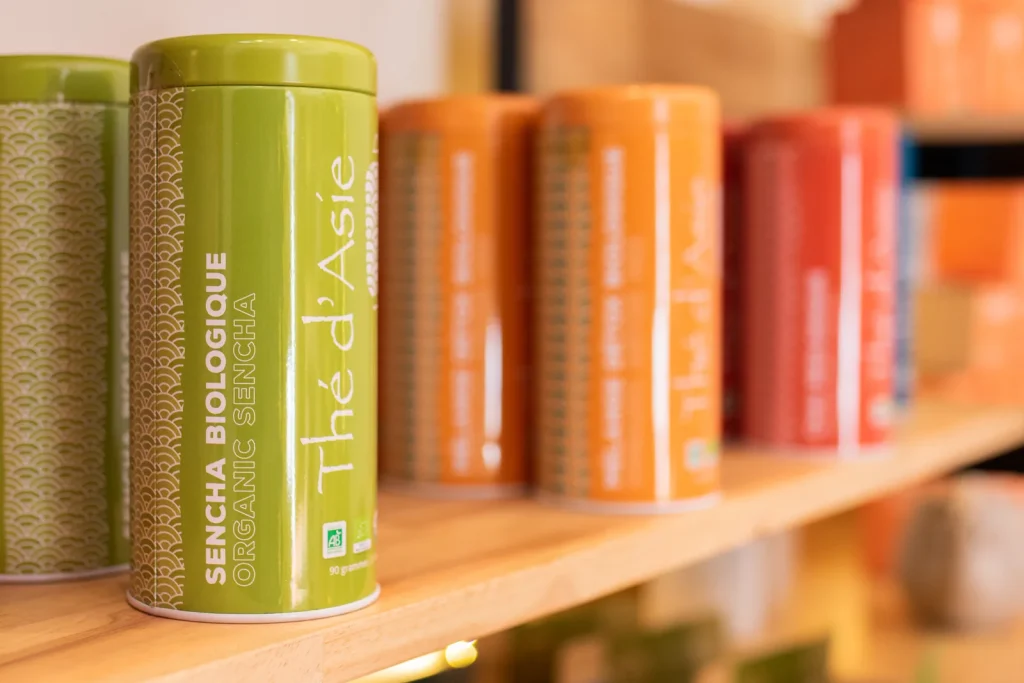
We are a French and Khmer family business. Our partner farm is in Kampot, our packing workshop is in Phnom Penh, and our Siem Reap shop carries our peppers, our fleur de sel, our teas and our infusions.
Our peppers are certified organic to both European and American standards, grown with no chemical fertilisers or synthetic insecticides. Hand harvested, hand sorted, hand packed. You can taste before you buy, we will walk you through the differences, and we pack for travel if you are flying out the same day.
If you are heading down to the coast, KHLA Lodge has five rooms among the pepper vines in Kampot.
Taking pepper home
Dried pepper travels very well. It keeps for years away from light and humidity, ideally whole and ground at the last moment. For flights, use checked luggage for large quantities and keep the original packaging sealed, which makes customs easier on arrival.
Most countries allow dried spices for personal use, but the rules vary. Check the ones for your destination before you load up two kilos.
Kandal Village, where you find something other than fridge magnets
Kandal Village is not a village, it is the name given to a few streets behind the Old Market, Psar Chas, where independent shops, sewing workshops, cafés and designer boutiques have settled. It is one of the few parts of Siem Reap where you can shop without twenty minutes of haggling and without wondering whether the object came out of a factory.
The difference with the souvenir lanes around Pub Street is simple: here the businesses have a name, a fixed address and something to defend. That does not make everything cheaper, it makes it clear what you are buying.
What is around, between two temples
People come to Siem Reap for the Angkor archaeological park first, and nobody needs us to tell them that. But temple days start early and finish early, and the afternoon leaves time.
The Old Market, Psar Chas, is a few minutes on foot from Kandal Village, and it is worth the detour if only for the spice and dried fish aisle, where you understand better what pepper means in a Khmer kitchen. The river and its banks can be walked. And the floating villages of the Tonlé Sap are a half day trip from town.
We recommend neither restaurants nor tours: it is not our trade and that kind of advice ages badly. If on the other hand you are wondering what to bring home rather than what to do today, our guide on what to bring back from Cambodia covers the whole question.
Three practical tips, for want of a better word
Buy early in the trip, not the night before the flight. Pepper and salt keep for years once closed, so there is nothing to gain by waiting and quite a lot to lose: the gift formats sell out first and red pepper is often missing.
Taste before you buy. We open the boxes at the counter, and the gap between a Kampot black and a supermarket pepper is obvious within a second. It is also the fastest way to choose between the four colours without reading three paragraphs.
If you are staying in a hotel and would rather not carry anything, we deliver within a perimeter around the shop, hotel delivery included. That also applies to purchases made early in the trip and collected just before you leave.
Frequently asked questions
Where is the best place to buy Kampot pepper in Siem Reap?
A farm shop, because it is the only place where you can taste, ask about the origin and get an answer that can be verified. Markets are cheaper but come with no guarantee.
How much does real Kampot pepper cost?
It depends on the colour, the format and the harvest year. Here are our current prices, updated automatically.
Our Kampot peppers
Can I visit a plantation from Siem Reap?
Not as a day trip, Kampot is at the other end of the country, right down south. It belongs on a coastal itinerary, not on a Siem Reap excursion.
Is there organic Kampot pepper?
Yes. The geographical indication guarantees origin, not farming method. They are two separate labels, and a pepper can carry one without the other. Ours carry both.
Can pepper sold as Kampot come from another country?
Yes, and it is the most frequent case. The variety grows elsewhere, notably in Thailand. The product is not necessarily bad, but it has neither the origin nor the inspections nor the right to the name. Only the PGI settles it.
Khla means tiger in Khmer. The last wild tiger was photographed in Cambodia in 2007, and two areas are now being studied to bring it back. That animal is where the house takes its name.